Leave whenever you like
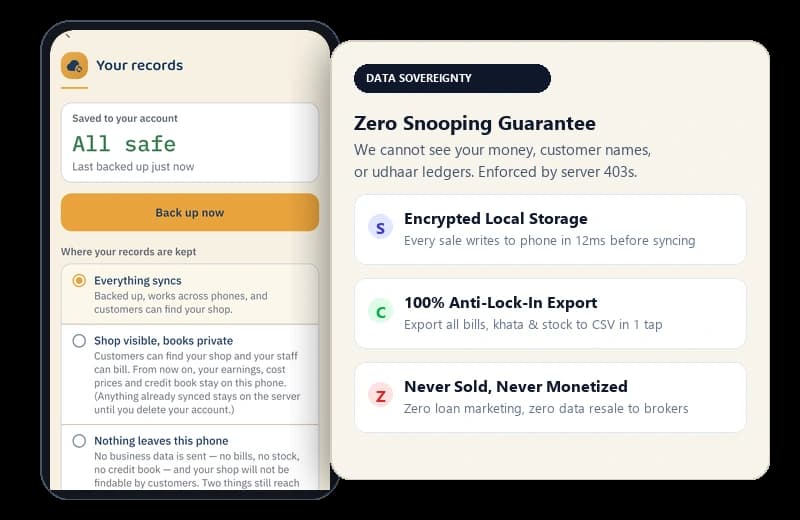
Bills, stock and the khata export to CSV, free, with no tier and no support request. Anti-lock-in costs us nothing and it is the fear worth answering first.
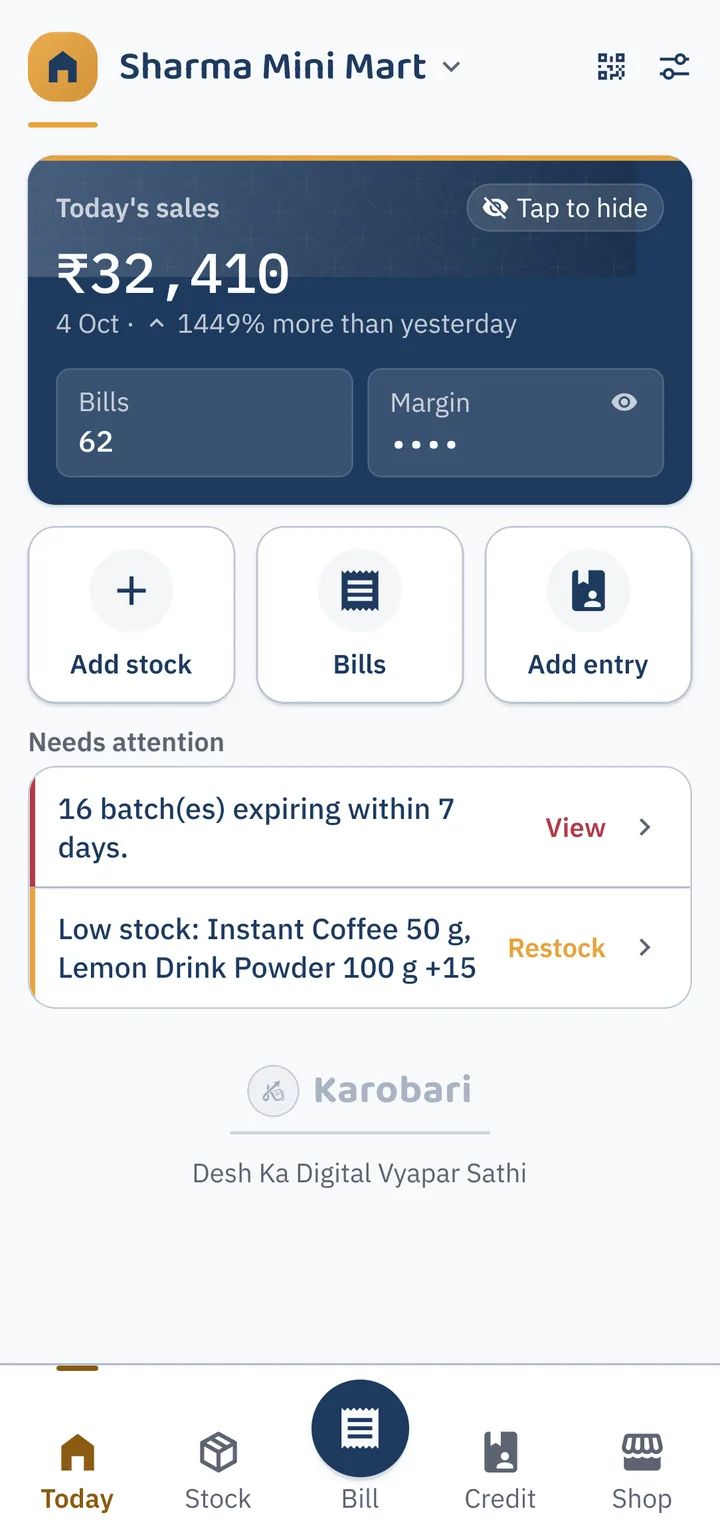
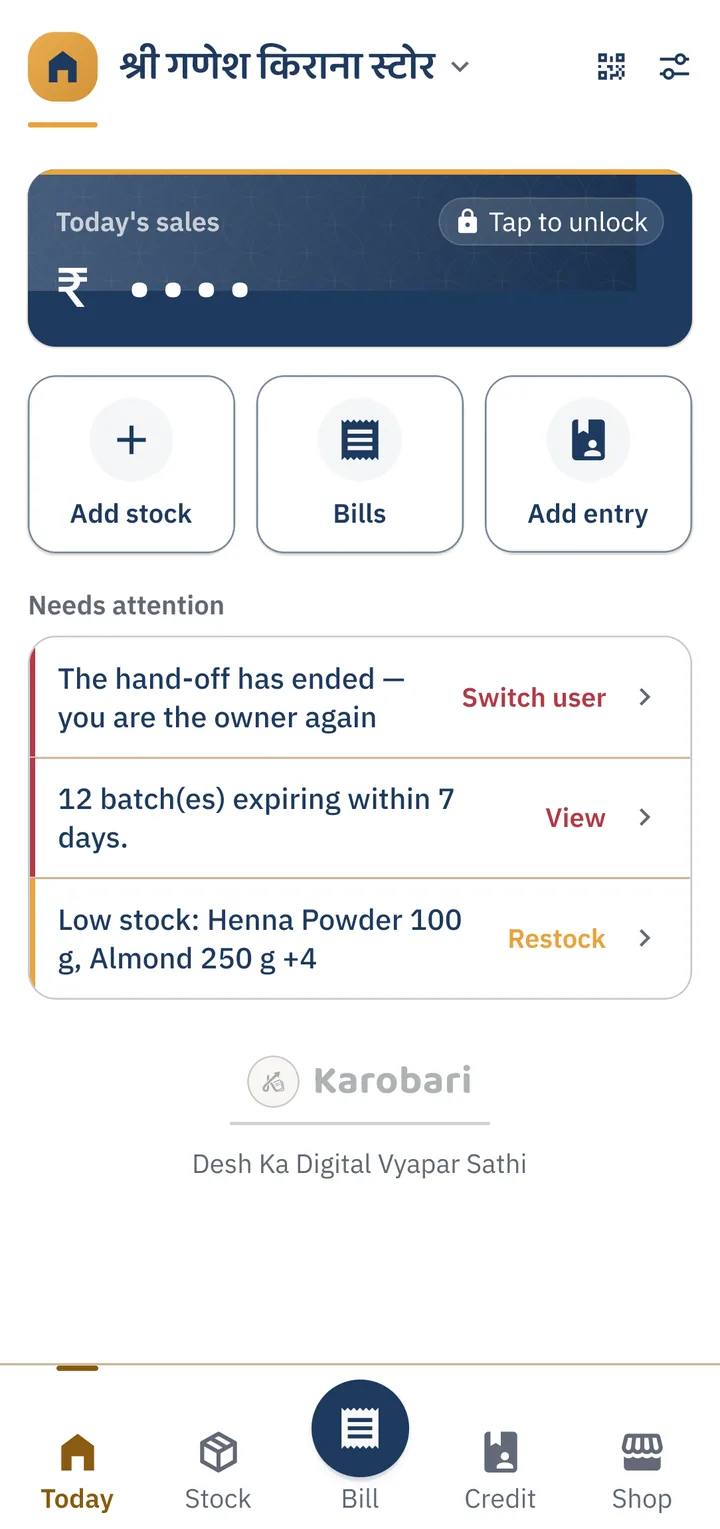
Not adjectives — a table. For each thing in your shop, who sees it: you, the boy at the counter, and us. Every “no” below is enforced by the server, which is the only kind of no that holds.
Support can tell whether your bills are syncing. They cannot open your khata, read a customer's name, or see a single rupee figure for your shop. It is not a policy we ask staff to follow — the endpoints do not return it.
A support conversation is “my bill did not sync” or “this product is flagged”. It is never “how much did you make”. A capability nobody needs only has a downside.
The middle column is why you can hand the phone to someone else during a rush. The third one is why you can hand us your books.
| Can read | You | Your staff | Us |
|---|---|---|---|
| The day's takingsदिन की कुल बिक्रीFirst thing on the owner's home screen. There is no setting that turns it on for staff, and none per shop for us. | Yes — you | No — your staff | No — us |
| Individual billsअलग-अलग बिलA staff member sees the bills they rang up themselves. Every bill records who made it, and only the owner reads across members. | Yes — you | Limited — your staff | No — us |
| The udhaar bookउधार खाताOwner-scoped in the data model, not by a screen that hides it. Customer names and balances are off limits to support by design, and the record is never sold or monetised. | Yes — you | No — your staff | No — us |
| Prices, and changing themरेट, और उन्हें बदलनाStaff read them. Changing one needs a permission you grant per person, off by default. A discount on a sale in front of them is bargaining, not a price change. | Yes — you | Limited — your staff | No — us |
| Which phones are signed inकौन-कौन से फ़ोन साइन-इन हैंSelf-only, and no role widens it. An owner removes a staff member's access by ending the membership — the control is over the job, not over their phone. | Limited — you | Limited — your staff | No — us |
| Whether the shop is syncingसिंक हो रहा है या नहींThe one row where the third column says yes, and it is why the rest of the column can be believed. A stuck sync has to be visible to us or it is found by the shopkeeper, late. | Yes — you | Yes — your staff | Yes — us |
The third column is the one worth reading twice. Most access tables in this category have two, because the company writing them is not a party in its own diagram.
Bills, stock and the khata export to CSV, free, with no tier and no support request. Anti-lock-in costs us nothing and it is the fear worth answering first.
One request removes the account and its data. The page that describes it is linked from inside the app, and it is a real process rather than a form that opens a ticket.
The app writes to the phone first and syncs after. If our servers vanished tomorrow, the bills you made today would still be on your handset.
No logo, no watermark, no 'sent via'. The receipt is the shop's signboard, not our billboard, so there is no de-branding to sell back to you later.
Two columns rather than a paragraph, because a promise you can check against a list is a different kind of promise.
The left column is short because it is only what the product needs to work. Anything that would make the right column shorter would have to be built on purpose, and this is the page it would have to be written on first.
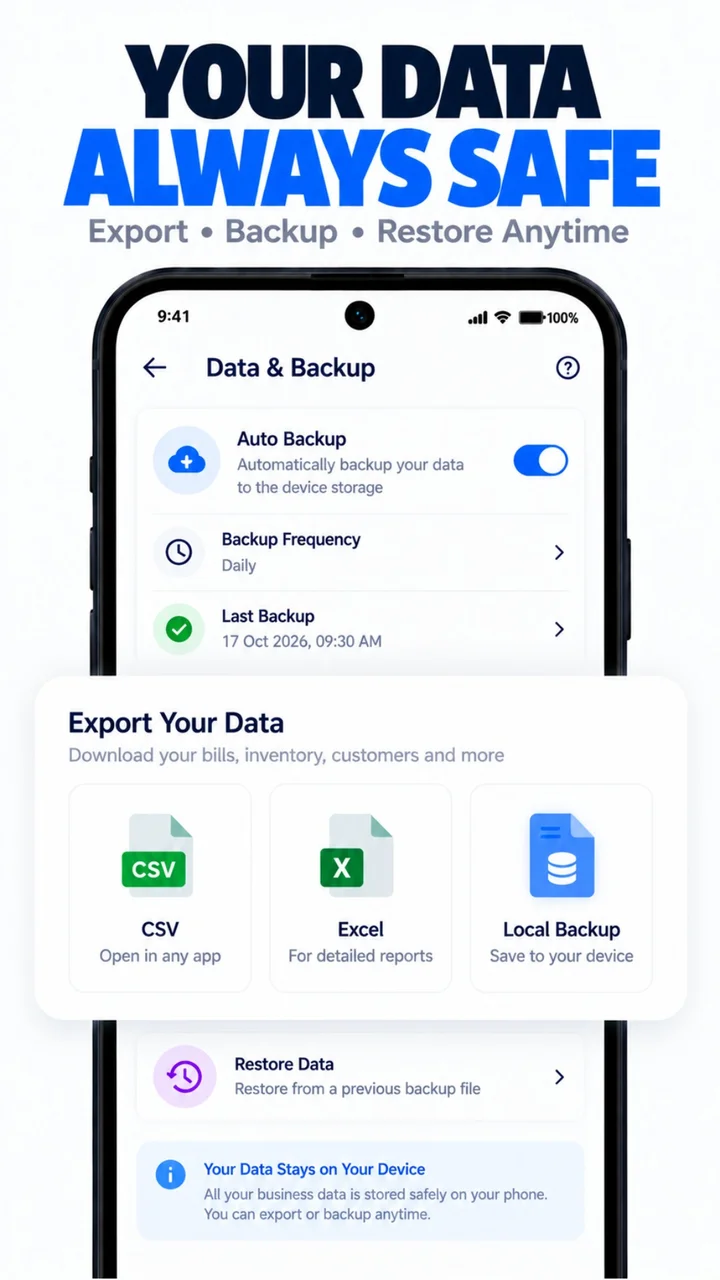
No lock-in, no ransom, and no cloud hostage tricks. Karobari stores your transactions, item catalogs, and customer credit ledgers locally on your device with automated daily backups to device storage.
Today it mostly doesn't need to. The app works offline, so it barely touches a server; the running cost of one shop is close to nothing. That is a real answer and it only works at this size, which is why the team is small.
Later, money comes from places where the value is already obvious — listing placement for shops that want it, ordering between businesses, analytics for people who ask for analytics. Never from the till.
Billing, stock, the udhaar book and sync do not become paid, get row limits, get a device count, or start charging to restore a backup. Those are the five ways this category usually monetises, and each one works by removing something that already worked.
A paid listing will also never be allowed to outrank a real search result. If we ever sell placement it is a separate, labelled, capped slot — not a thumb on the scale.
No, and the sharpest version of that promise is about the khata specifically: the udhaar book is never sold, never shared, and never monetised. It is the record of a relationship that existed before this app and will outlast it.
Lending against your transaction history is the obvious way to make money here. It is also the obvious way to lose the trust the whole thing depends on, and it is written down internally as a decision that cannot be made quietly.
A small team building this in India, in the open, with a support address you can talk to a human in. There is no growth team and no ad budget — which is also why you found this page rather than an advertisement.
Every security page on the internet says “bank-grade” and “encrypted”. Here is where those words would be doing more work than they deserve.
Nobody worries about a shop app until the network drops mid-sale. That is a separate page, and it is the one that shows the actual mechanism.